Technical leaders are often expected to have the answer quickly. Experience and expertise create that expectation: when a problem arises, people look to you for direction.
But a quick answer can commit a team to solving the wrong problem. It can also close off a useful perspective before anyone has heard it.
Good judgment starts before the recommendation. It involves understanding what needs to be decided, gathering relevant input, drawing on experience, and recognizing when it is time to act.
These practices matter in technical work, but their value extends to decisions about people, strategy, careers, and businesses. The questions may differ. The responsibility to think carefully and move forward remains.
The question presented to you may already contain a proposed solution.
“We need a new system.”
“We need to hire another person.”
“I need to find a different job.”
Each may be a reasonable conclusion. Before accepting it, understand what is driving the request.
A proposed system upgrade raises questions about what the system must do now and in the future. Is the current system failing to meet a requirement? Has demand changed? Does the team need greater reliability, additional capacity, or a capability it does not currently have?
A request to hire may reflect a true capacity gap. It may also reveal unclear responsibilities, competing priorities, or work that no longer serves a useful purpose. Those possibilities lead to different actions.
A career decision deserves the same attention. Someone considering a move may be seeking advancement, a different working environment, more meaningful work, or room to pursue business ownership. Identifying the underlying objective helps them evaluate opportunities against what actually matters.
Before discussing solutions, ask:
A clear definition gives the discussion a shared reference point. It also makes it easier to recognize a solution that looks attractive but does not address the real issue.
Technical expertise helps you interpret information. It does not give you access to every relevant fact or perspective.
Gather evidence from different sources and speak with people who understand aspects of the situation you may not see. Include those who will implement the decision, live with its consequences, or challenge your thinking.
For a project, that could mean talking with operations, maintenance, commercial teams, and the people responsible for execution. For a people decision, it could mean understanding the team's workload and expectations before interpreting a performance concern. For a business decision, it could mean testing an attractive idea through customer conversations and financial information.
The purpose is to improve your understanding. You still need to assess the input, resolve conflicting priorities, and take responsibility for the recommendation.
Two useful questions are:
What am I missing?
Who sees this differently, and why?
AI can help explore options, organize information, and develop questions. Check consequential claims against credible sources, firsthand knowledge, and real conversations. Several AI-generated responses that repeat the same claim do not establish independent confirmation.
When sources disagree, examine the reasons. They may be using different assumptions, describing different conditions, or working toward different objectives. Understanding those differences can be more useful than choosing the answer that sounds most confident.
In project development, the last comparable project may be decades old. The experts involved may no longer be available, and the technology may have evolved.
The lessons still matter, but someone has to find them and determine what remains applicable.
Past experience offers a starting point. Examine the conditions behind the earlier outcome: the resources available, the people involved, the constraints, and the assumptions that proved right or wrong.
Then identify what has changed.
A previous project's execution plan may contain useful lessons even when its equipment is outdated. A leadership experience in one industry may help you navigate competing priorities in another. Lessons from a difficult career transition may help you ask better questions about a new opportunity.
Look outside your field when the underlying challenge is comparable. Coordinating stakeholders, managing uncertainty, and sequencing commitments appear in many settings.
Then consider the future consequences of your choice:
Intuition belongs in this process, too. A feeling that something is off may reflect a pattern you recognize from experience. Ask what is informing that reaction and what evidence would support or challenge it. Use the signal to guide further inquiry.
Careful thinking needs a purpose and a time boundary.
Understand when an answer is truly needed. Weigh what is at stake against the cost of waiting, and consider how easily the decision could be changed later.
Some choices deserve substantial investigation because they create long-term commitments. Others can be tested through a limited step before committing further.
For example, a business owner might test demand through a small pilot. A professional considering a career move might speak with people doing the work before investing in a lengthy qualification. A leader evaluating a new process might trial it with one team.
Ask what additional information could materially change your choice. That question helps distinguish necessary investigation from continued analysis that adds little value.
Set a decision point and define what you need to know by then. If important uncertainty remains, decide how you will manage it: through a test, a contingency, a staged commitment, or further investigation with a clear deadline.
Recognize when you know enough to move forward. Waiting for complete certainty can carry its own cost.
Think of a consequential decision you are facing now. Which part needs more attention: the real issue, the evidence and perspectives, the lessons and future consequences, or the timing?
Before giving your answer, make clear what you recommend, why it fits, what it depends on, and what would cause you to reconsider.
That gives others a basis for understanding your judgment and acting on it. It also helps you move deliberately when the decision carries real consequences.
If you are navigating a major transition or a consequential decision, Achieve Coaching & Consulting offers strategic advisory support to help you clarify the issue, evaluate your options, and move forward. Explore how we can work together.
Post summary: Strong technical leadership requires judgment before an answer. Explore four practical ways to clarify decisions, seek useful input, apply experience, and move forward at the right time.
SEO title: Better Decisions for Technical Leaders | AchieveCC
SEO description: Four practices to help technical leaders clarify the real issue, verify input, apply experience, and make timely strategy, people, career, and business decisions.
Suggested URL slug: technical-leaders-better-decisions
Featured image: SM-104-Social-Image.png
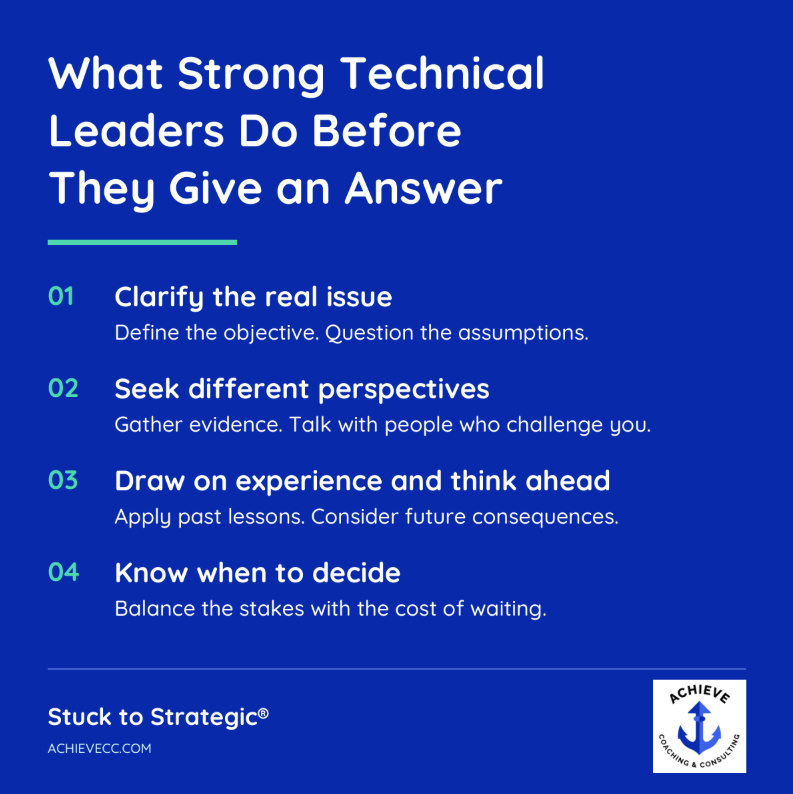
Image alt text: Four practices for technical leaders before giving an answer: clarify the real issue, seek different perspectives, draw on experience and think ahead, and know when to decide.


